
Key Differences You Should Know
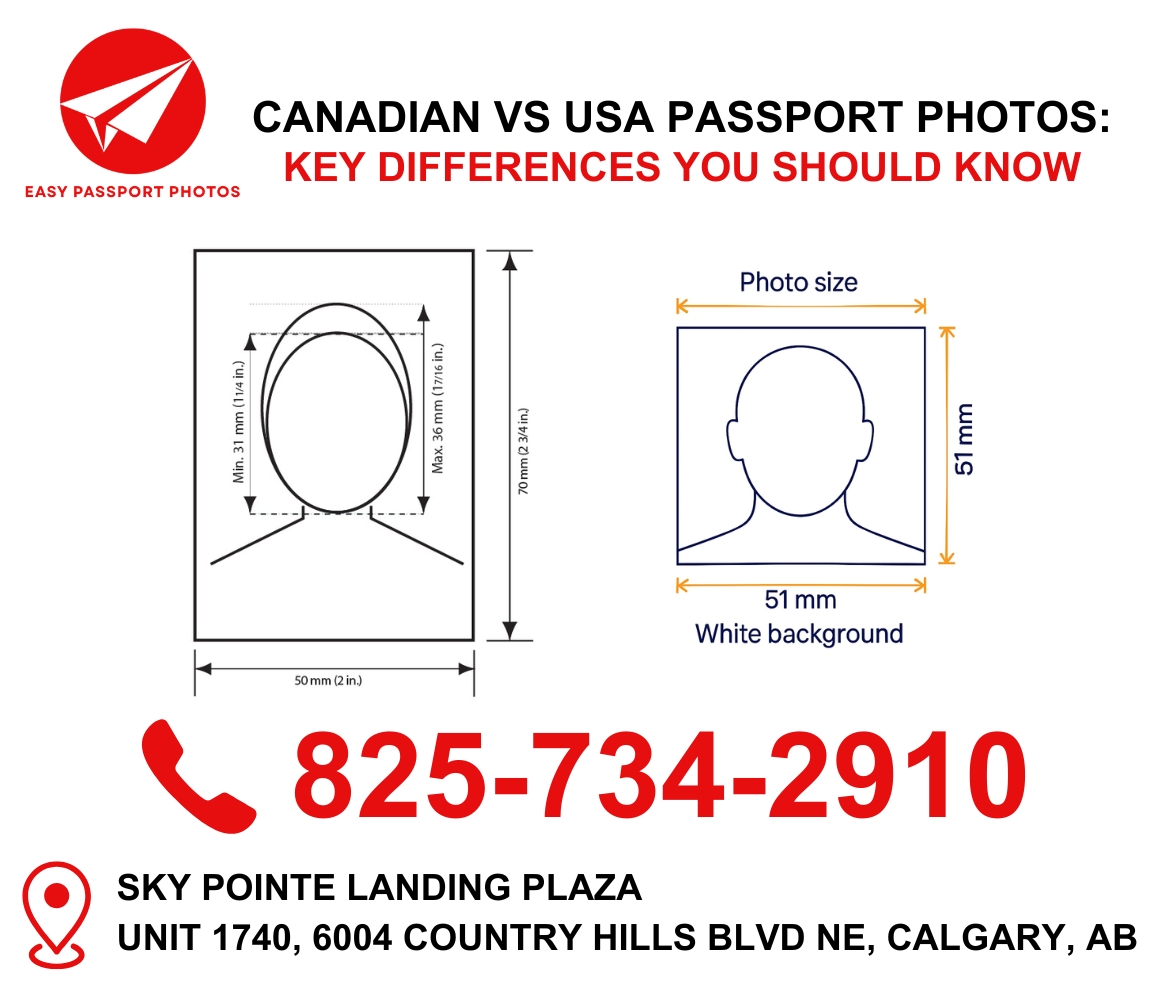
Canadian and US Passport Photos: Passport photos may look simple, but every country has strict rules for size, background, facial expression, and photo quality. If the photo does not meet the government’s specifications, your passport application can be delayed or rejected. This is why it’s important to understand the exact requirements for each country.
Canada and the United States have similar passport photo guidelines, but there are several important differences in size, measurements, and photo formatting. Whether you are applying for a new passport, renewing one, or submitting documents for visas or immigration, knowing these differences can help you avoid unnecessary delays.
This guide explains the major differences between Canadian and U.S. passport photos so you can make sure your photo meets the correct requirements.
Passport Photo Size
One of the biggest differences between Canadian and U.S. passport photos is the physical size of the photo.
Canadian Passport Photo Size
Canadian passport photos must be:
- 50 mm wide x 70 mm high (2 inches x 2 ¾ inches)
The head size must also fall within a specific range:
- The face height (chin to crown) must measure 31 mm to 36 mm
This means Canadian passport photos are slightly taller than U.S. photos and require more precise head measurements.
U.S. Passport Photo Size
U.S. passport photos are simpler in terms of dimensions:
- 2 inches x 2 inches (51 mm x 51 mm)
The head size requirements are:
- The head must measure 1 inch to 1 3/8 inches (25 mm – 35 mm) from chin to top of head.
Because the U.S. photo is square, it is easier to crop compared to the rectangular Canadian photo.
Digital Pixel Dimensions
In today’s digital application systems, pixel resolution is extremely important. Many applications now require digital passport photos for online submissions.
Canadian Passport Photo Pixels
For digital applications, Canadian passport photos must typically meet the following specifications:
- Minimum dimensions: 420 x 540 pixels
- Recommended dimensions: 1200 x 1600 pixels or higher
- Aspect ratio: 5:7 (same as 50 mm x 70 mm)
The head size must occupy:
- 50% to 69% of the total image height
The file must also meet these requirements:
- JPEG format
- High resolution
- No digital filters
- Natural color balance
Because Canada uses a 5:7 ratio, resizing incorrectly can distort the image or cause rejection.
U.S. Passport Photo Pixels
For online applications such as renewals or visa forms, the United States requires specific pixel dimensions.
U.S. passport photo digital requirements include:
- 600 x 600 pixels minimum
- 1200 x 1200 pixels maximum
- Square aspect ratio (1:1)
Head size must measure:
- 300 to 420 pixels from chin to top of head
Other digital requirements include:
- JPEG format
- File size under 240 KB
- Natural color
- No compression artifacts
Because the photo is square, resizing and cropping is usually easier than Canadian passport photos.
Background Requirements
Both countries require a clean, plain background, but the exact expectations differ slightly.
Canadian Passport Photo Background
For Canadian passport photos:
- Background must be plain white or light-colored
- No shadows behind the head
- Background must be evenly lit
- No patterns or textures
Professional studios often use special lighting to ensure the background is completely uniform, which helps prevent rejection.
U.S. Passport Photo Background
The United States also requires:
- Plain white or off-white background
- No shadows or objects
- No textured or colored backgrounds
In general, U.S. background requirements are slightly more flexible than Canadian ones, but the background still must appear clean and neutral.
Facial Expression Rules
Both countries have strict rules regarding facial expressions to ensure biometric recognition works properly.
Canadian Passport Photo Expression Rules
Applicants must:
- Maintain a neutral facial expression
- Keep the mouth closed
- Look directly at the camera
- Keep both eyes open and visible
Smiling is not allowed, even a slight smile. This ensures consistency in identity verification.
U.S. Passport Photo Expression Rules
U.S. rules are similar:
- Neutral expression preferred
- Both eyes open
- Face the camera directly
However, the U.S. allows a very natural expression, which may include a slight neutral smile. Still, exaggerated expressions or visible teeth are not allowed.
Want to know tips how you can prepare your child for passport photos. Click Here.
Glasses and Head Coverings
Rules about glasses and head coverings are another area where passport regulations matter.
Canadian Passport Photo Rules
In Canadian passport photos:
- Glasses are generally not recommended
- If worn, there must be no glare
- Eyes must be clearly visible
- Sunglasses are not allowed
Head coverings are only allowed for religious or medical reasons, but the face must remain fully visible from chin to forehead.
U.S. Passport Photo Rules
The U.S. has stricter rules regarding glasses.
- Glasses are not allowed in passport photos
- Exceptions require medical documentation
Head coverings are allowed only for religious or medical reasons, with the same rule that the full face must remain visible.
Photo Quality and Printing
Photo quality is extremely important for both countries, as poor image quality can lead to rejection.
Canadian Passport Photo Quality
Canadian passport photos must:
- Be printed on high-quality photographic paper
- Have no digital alterations
- Be clear and sharp
- Show natural skin tones
- Have no shadows or glare
Another unique Canadian requirement is that the photographer must stamp or write studio information on the back of one photo. This includes:
- Studio name
- Address
- Date the photo was taken
This verification confirms that the photo was taken professionally.
U.S. Passport Photo Quality
U.S. passport photos must also:
- Be printed on photo-quality paper
- Have no filters or digital editing
- Be high resolution
- Show accurate colors and natural lighting
Unlike Canadian photos, U.S. passport photos do not require a studio stamp on the back.
Number of Photos Required
Another difference between Canadian and U.S. passport applications is the number of photos needed.
Canada
Most Canadian passport applications require:
- Two identical photos
One photo must include the photographer’s stamp and signature.
United States
The United States typically requires:
- One passport photo
This simplifies the submission process compared to Canada.
Photo Validity Period
Photos must also be taken within a specific time frame before submitting your application.
Canadian Passport Photos
Canadian photos must be taken within the last 6 months to ensure they accurately represent your current appearance.
U.S. Passport Photos
The United States has the same rule. Photos must be taken within the last 6 months.
Common Reasons Passport Photos Are Rejected
Both countries reject thousands of passport photos each year due to simple mistakes. Some of the most common reasons include:
- Incorrect photo size
- Shadows on the background
- Poor lighting
- Smiling or incorrect facial expression
- Wearing glasses
- Low-quality printing
- Digital filters or editing
- Incorrect head size
Because of these strict rules, many applicants choose professional passport photo studios instead of taking photos at home.
Which Passport Photo Is Harder?
Many people find Canadian passport photos slightly more challenging because:
- The photo size is unique (50 x 70 mm)
- The face measurement requirements are strict
- The studio stamp requirement must be included
U.S. passport photos are easier because the 2 x 2 inch square format is widely used and easier to crop.
However, both countries maintain strict guidelines to ensure photos meet biometric identification standards. At Easy Passport Photos, we ensure that.
Conclusion
Canadian and US passport photos may seem similar at first glance, but the differences in size, measurements, and submission requirements can easily cause confusion. Canada requires a taller photo with precise head measurements and a photographer’s stamp, while the United States uses a simple square format and requires only one photo.
Understanding these differences is essential for anyone applying for passports, visas, or immigration documents. Submitting the correct photo the first time helps avoid delays and ensures your application process moves forward smoothly.
If you are unsure whether your photo meets the requirements, visiting a professional passport photo studio is often the safest option. Professionals are familiar with the exact specifications for different countries and can ensure your photo is fully compliant.
In the end, a properly taken passport photo saves time, prevents application rejection, and helps you travel without unnecessary complications.
📍 Visit us today:
Easy Passport Photos – Sky Pointe Landing Plaza
Unit 1740, 6004 Country Hills Blvd NE, Calgary, AB
📞 825-734-2910